Most hallways get nothing. They are painted whatever the landlord painted them, lit by one ceiling light, and treated as the space you walk through to get to the rooms that matter. That is exactly why a little attention goes so far here: a hallway that feels intentional makes the whole home feel intentional, because you pass through it every single day.
The catch for renters is that a hallway is also the hardest room to decorate badly and then fix. It is narrow, so anything that sticks out too far becomes an obstacle. It is often dark, so colours that look soft in a living room can look muddy here. And it is usually the last place you would want to lose a deposit over, for a room you barely live in.
This guide is built for that reality: small hall design ideas for renters, using light, colour, wallpaper, art, and mirrors — all removable, all corridor-focused — so a long, narrow, or dark hall feels like part of your home, not an afterthought.
Table of Contents
[Hide]- What kind of hallway do you have — long, narrow, dark, or all three?
- Lightening a dark hallway with no natural light
- Long hallway walls — art, mirrors and spacing
- Narrow hallway wallpaper ideas (renter-friendly, test patch first)
- Hallway paint colours (and renter alternatives if you cannot paint)
- Small hall design — console, hooks and what not to block
- Lighting — no-drill options for a hallway
- FAQ
- How do I decorate a hallway without making it feel narrower?
- How do I lighten a dark hallway with no windows?
- Can I use peel-and-stick wallpaper in a narrow hallway?
- Can I paint my rental hallway?
- What furniture fits in a small hallway?
What kind of hallway do you have — long, narrow, dark, or all three?
Before you buy or hang anything, name your hallway’s problem, because long, narrow, and dark hallways need different fixes — and a hallway that is all three needs them in the right order.
- Long: The problem is emptiness. A long, bare wall feels like a tunnel, and the far end feels miles away. The fix is rhythm: repeated art, mirrors, or lighting that breaks the wall into sections, so the eye travels in steps instead of one long stare.
- Narrow: The problem is width — or the lack of it. Anything deep, bulky, or jutting out makes the hall feel tighter and harder to walk through. The fix is flat: art and mirrors on the walls, colour and wallpaper that add interest without depth, and furniture that is shallow or not there at all.
- Dark: The problem is light, especially a hallway with no natural light and no window at all. The fix is not a brighter bulb alone — it is lighter surfaces, reflective finishes, and layered light that stops the hall from feeling like a tunnel at night as well as during the day.
- All three: Start with light, then colour, then walls. There is no point hanging art in a hall you cannot see, and no point choosing a wallpaper pattern before you know how light it will look in that specific hall. Work in that order and each step makes the next one easier to judge.
Measure your hallway before you plan anything: its length, its width at the narrowest point (including doors that open into it and radiators), and its ceiling height. Those three numbers decide what fits, what does not, and whether a console, a mirror, or a wallpaper pattern is realistic at all. Keep a clear walking path — if you cannot walk through comfortably with your arms slightly out, something needs to go.
Lightening a dark hallway with no natural light
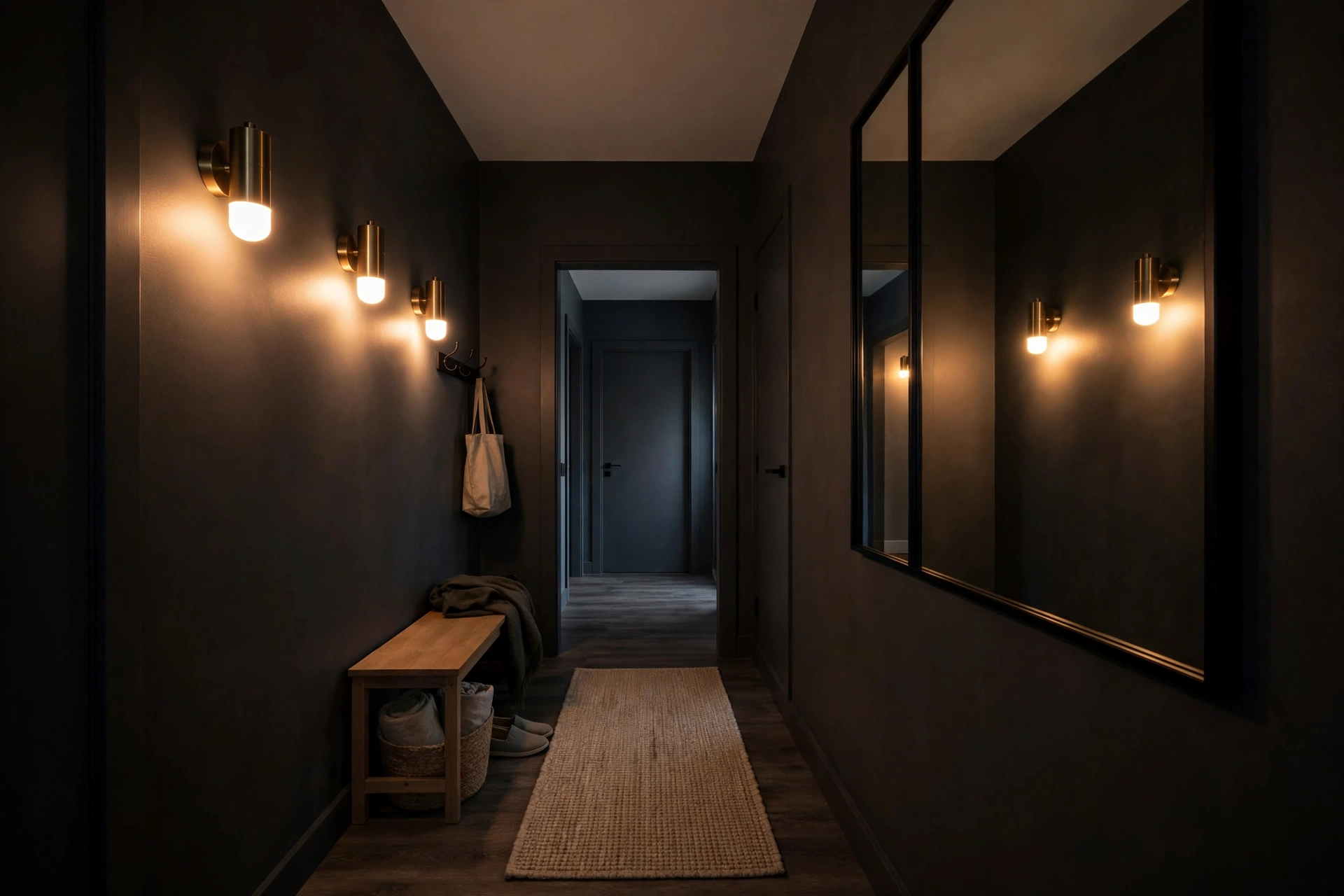
Learning how to lighten a dark hallway with no natural light is the single highest-value change in this guide, because light affects every other decision. A dark hall is not just dim — it makes colours look darker, art look flat, and the whole space feel smaller than it is.
Start with the surfaces, not the bulbs. Light-coloured walls, a light runner or rug, and a light ceiling bounce whatever light exists back into the room. If you cannot paint, the renter alternatives in the paint section below — peel-and-stick wallpaper in a light pattern, large light-coloured art, and mirrors — do much of the same work without touching the paint. A dark rug in a dark hall, however beautiful, absorbs the little light there is; if you love a dark rug, keep it for a room with windows.
Next, layer the light instead of relying on one ceiling fitting. One overhead light in the middle of a long hall leaves both ends in shadow. Battery-operated wall lights, plug-in picture lights, or a small lamp on a console (where there is room for one) create pools of light along the hall, so no stretch is fully dark. Keep to no-drill options in a rental — adhesive or freestanding lights, following the maker’s instructions for the wall surface and weight — and get landlord permission in writing before anything that screws, drills, or wires into a fixed fitting. For more no-drill lighting ideas that work beyond the hallway, see the cozy ambient lighting guide linked below.
Then, use reflection deliberately. A mirror opposite or near a light source doubles that light visually; a mirror at the far end of a long hall pulls the eye forward and makes the hall feel shorter and brighter. Glossy or satin finishes on frames and furniture reflect more light than matte ones. None of this creates natural light where there is none — but together, light surfaces, layered light, and reflection can take a hall from gloomy to genuinely welcoming.
Finally, check the practical things that steal light: a dirty light cover, a bulb that has dimmed with age, or a door that is always closed. Cleaning a light cover and replacing a tired bulb costs almost nothing and is often the first visible improvement. Keep hallway doors open where you can, so light from adjoining rooms spills in — it is free, and it works immediately.
Long hallway walls — art, mirrors and spacing
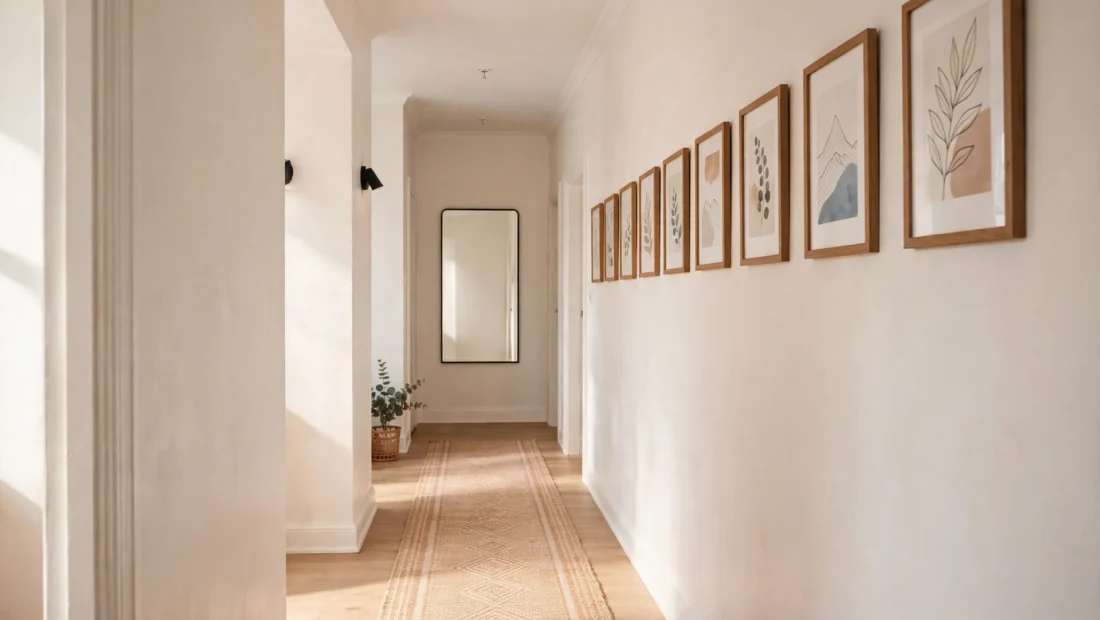
Knowing how to decorate hallway walls in a long hall is mostly a spacing problem. One small picture in the middle of a long wall looks lost. A wall covered edge to edge looks cluttered. The middle ground is rhythm: a repeated series, evenly spaced, that gives the eye somewhere to land every few steps.
A simple method that works in most long hallways:
- Pick one series, not a collection. Three to five frames in the same size and frame colour, hung in a straight line at eye level, read as one deliberate idea. Mixed sizes and frames can work, but they need more wall width and more planning to avoid looking accidental.
- Space by walking, not by measuring alone. Stand in the hall and walk it. Frames should feel evenly spaced as you move, not just when you stand still in front of one. As a starting point, even gaps between frames — rather than one cluster at one end — keep the rhythm steady down the whole wall.
- Hang at eye level for a hallway, not gallery height. In a narrow hall you stand close to the wall, so art hung too high feels disconnected. Eye level for the people who live there is the right height; in a hall used mainly by adults, that is roughly the height your eyes are when standing.
- Use mirrors to break up art, not just to decorate. A mirror between two framed pieces reflects light and gives the wall variety without adding another picture to look at. In a dark hall, this also serves the lightening goal from the previous section.
- Leave the far end a destination, not a dead end. A larger piece, a mirror, or a small console (if width allows) at the end of a long hall stops the eye from running off into nothing. It turns a tunnel into a route with an ending.
Hang everything renter-safely: removable adhesive hooks and strips rated for the frame’s weight and your wall surface, following the maker’s instructions and removal steps exactly. Test in a hidden spot first, and do not hang a heavy mirror or frame on adhesive alone — follow the maker’s weight guidance, and get landlord permission in writing for anything that needs a screw or nail. Keep original fittings and fill nothing you cannot restore.
Narrow hallway wallpaper ideas (renter-friendly, test patch first)
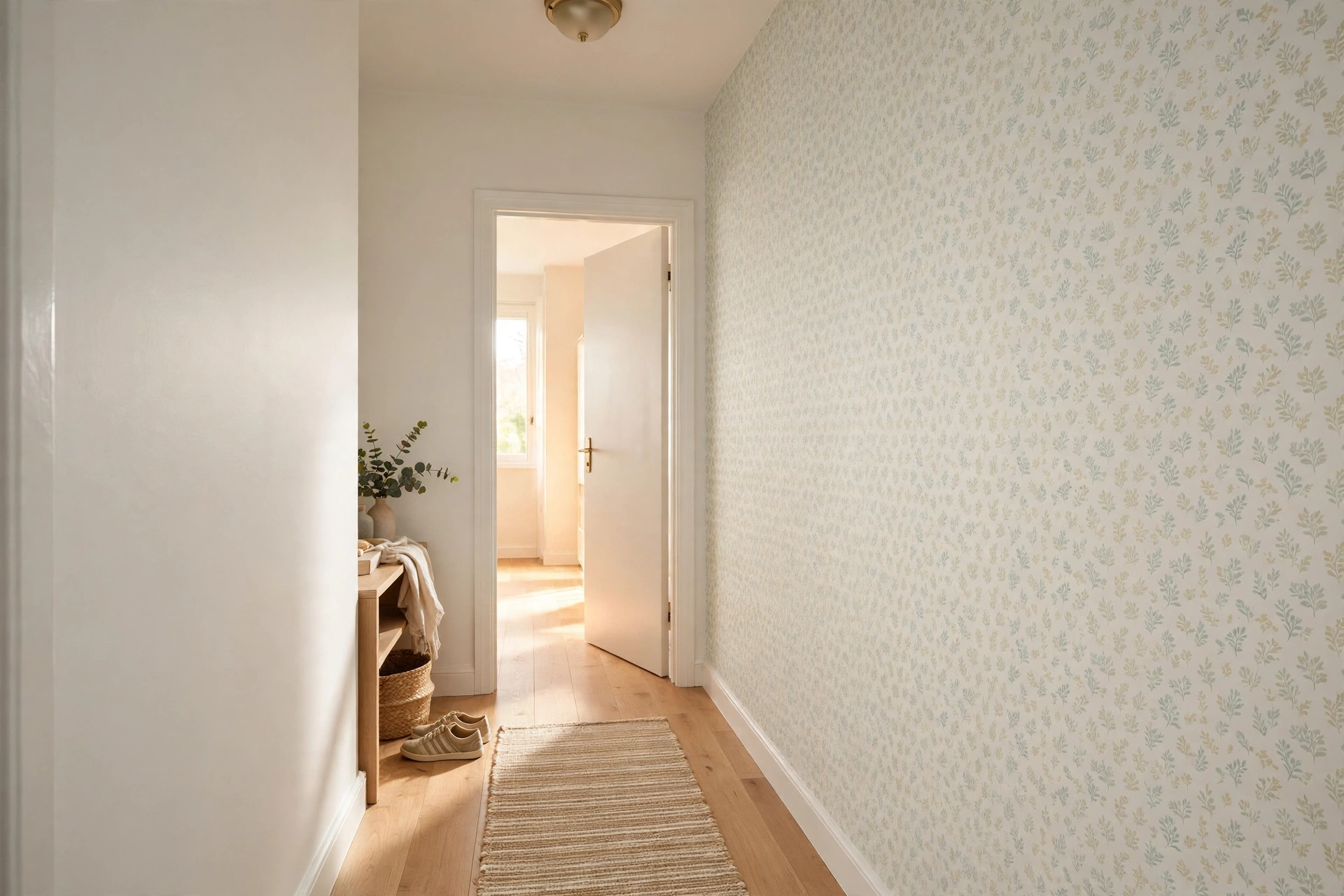
Narrow hallway wallpaper ideas are where renters have the most to gain — and the most to get wrong. In a narrow hall, wallpaper is not background decoration; it is the main event, because the walls are so close. The right pattern adds interest and light. The wrong one makes the hall feel even narrower.
Choose pattern by effect, not just by taste:
- Light backgrounds first. In a narrow or dark hall, a light-coloured wallpaper with a small, subtle pattern keeps the walls feeling open. A dark, large-scale pattern on both walls of a narrow hall closes the space in fast.
- Small pattern over large pattern. A small-scale print, a subtle stripe, or a tone-on-tone texture adds interest without shouting. A large, high-contrast motif needs wall width and viewing distance a narrow hall does not have.
- One wall, not both, if you are unsure. Papering a single long wall — or even a single section of it — gives you the wallpaper effect with half the visual weight and half the removal work at move-out. In a very narrow hall, one feature wall often looks more deliberate than both walls papered.
- Vertical interest over horizontal busyness. Stripes or vertical motifs draw the eye up and make a low hall feel taller. Busy horizontal patterns can chop a long hall into restless sections.
And the renter rule that matters most: test patch first. Peel-and-stick wallpaper behaves differently on painted walls, textured walls, and in humid or steamy conditions near a bathroom door. Apply a test patch in a hidden spot, leave it for the time the maker recommends, then remove it exactly as the maker instructs and check the wall underneath. If it lifts paint, leaves residue, or will not sit flat on your wall texture, you have learned that cheaply — before papering a whole hall. For full guidance on choosing, applying, and removing peel-and-stick wallpaper, see the peel-and-stick wallpaper rental guide linked below. Do not apply wallpaper over damaged, peeling, or damp walls, and do not present any wallpaper product as bathroom- or moisture-safe unless the maker rates it for that use.
Hallway paint colours (and renter alternatives if you cannot paint)
Hallway paint colors — and small hallway colour ideas more generally — follow one rule in a small hall: lighter and warmer beats darker and cooler, unless the hall has generous natural light to carry a deeper colour.
Colours that tend to work in a long, narrow, or dark hall:
- Warm whites and pale warm neutrals — the safest choice for a dark hall, because they bounce light and do not turn grey in low light the way cool whites can.
- Pale warm greys and soft sage — a little more character than white, still light enough for a narrow hall, and forgiving next to the wood tones of doors and floors.
- One deeper accent, used sparingly — a deeper colour on the far end wall of a long hall can make that wall feel closer and the hall feel shorter, which is exactly what a tunnel-like hall needs. Use it on one wall only, not the whole hall, and only if the hall has enough light to carry it.
If you cannot paint — and most renters cannot, or should not without written landlord permission — you can get most of the same effect without paint. Light peel-and-stick wallpaper (see above), large light-coloured art, light runners, mirrors, and warm-toned lighting all shift a hall’s colour temperature without touching the walls. A runner in a warm, light tone does more for a hall’s colour than a dozen small accessories, because it covers the floor you look down at with every step.
Whatever route you take, test colour in the actual hall, not in the shop or on a screen. Colours look different under hallway lighting than under shop lighting, and different again at night. Hold a sample, a fabric swatch, or a wallpaper sample up in the hall itself, in daylight and in the evening, before committing to a whole wall. If you do get permission to paint, keep a record of the original colour and finish so you can restore it at move-out.
Small hall design — console, hooks and what not to block
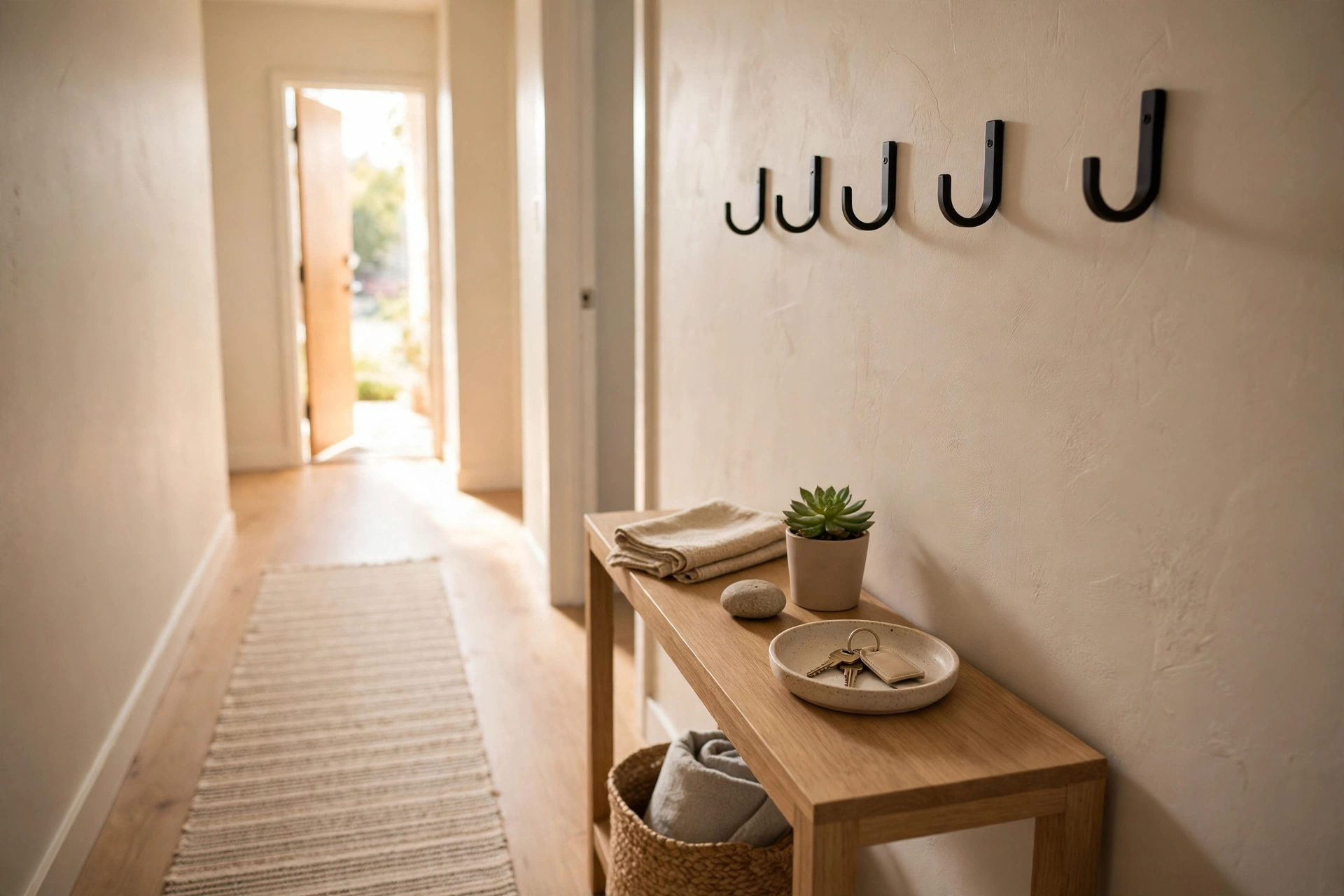
Small hall design is where good intentions become obstacles. A console table, a coat rack, or a shoe bench can make a hall genuinely useful — or can turn it into an assault course. The test is always the same: can two people pass comfortably, can doors open fully, and can you carry something through without turning sideways?
If your hall is wide enough for furniture, keep it shallow and purposeful:
- A narrow console — shallow enough that it does not eat the walking path — gives you a place for keys, post, and a small lamp. Anything deeper than the space allows is not a console; it is a blockage.
- Wall hooks, not a freestanding rack — hooks keep coats and bags flat against the wall, where they take up the least depth. A freestanding coat stand in a narrow hall takes floor space you do not have.
- One small tray or bowl for keys — on the console, by the door, in the same place every day. A hall earns its keep by being the place where you never lose your keys, not by storing everything you own.
What not to block, ever: fire exits and escape routes, radiators and heaters, electrical panels and meters, and doors that need to open fully. Do not put furniture in front of a radiator — it blocks heat and can be a fire risk — and do not hang anything over an electrical panel or meter that needs access. If a piece of furniture means a door cannot open fully or a radiator cannot breathe, it does not belong in the hall, however useful it looks.
And what not to store in a hallway: this is a corridor, not a storeroom. Shoe storage, coat storage, and entrance organisation belong in the entryway, not spread down the hall. If your hall is doubling as your entryway because your home has no separate entrance zone, keep that storage to one shallow, contained spot near the door — and see the entryway guides linked below for the full approach, rather than duplicating entry storage down the whole corridor.
Lighting — no-drill options for a hallway
Hallway lighting deserves its own section because a hall has lighting needs no other room has: it needs to be safe to walk through at night, welcoming when you come home, and cheap to run when it is on for hours. Drilling and rewiring are not the answer in a rental — layered, no-drill light is.
Options that work in a rental hallway, without drilling or rewiring:
- Battery-operated wall lights — mounted with removable adhesive, following the maker’s surface and weight guidance. Place them at intervals down a long hall so no stretch is dark, rather than clustering them at one end.
- Plug-in picture lights or small lamps — where a socket exists, a small lamp on a console or a picture light over art gives warm, focused light exactly where you look. Keep cables flat against the wall and out of the walking path.
- Motion-sensor night lights — low, plug-in or battery lights near the floor for safe night-time passage, especially in a hall used by children or older visitors, or a hall with steps or a turn.
- A brighter, warmer bulb in the existing fitting — check the fitting’s bulb type and wattage first. Replacing a tired or harsh bulb is the simplest lighting upgrade there is, and it costs almost nothing.
Keep the colour temperature consistent. Mixing a cool white ceiling light with warm wall lights makes a hall feel patchy. Warm white throughout is usually the most welcoming choice for a home hallway, and it flatters the warm wall colours and wood tones recommended above. For a fuller guide to warm, no-drill lighting in a rental, see the cozy ambient lighting guide linked below.
FAQ
How do I decorate a hallway without making it feel narrower?
Keep everything flat or shallow: art and mirrors on the walls, light colours, small-pattern wallpaper on one wall if any, and furniture that is shallow or absent. Avoid deep furniture, dark large-pattern wallpaper on both walls, and anything that juts into the walking path. Add light — light surfaces, mirrors, and layered no-drill lighting — because a brighter hall always feels wider than a darker one of the same size.
How do I lighten a dark hallway with no windows?
Use light surfaces, a light runner, mirrors near light sources, and layered no-drill lighting instead of one ceiling light alone. Clean the light cover, replace a tired bulb, and keep doors to lit rooms open where you can so light spills in. You cannot create natural light, but light colours plus reflection plus layered light together make a windowless hall feel genuinely brighter.
Can I use peel-and-stick wallpaper in a narrow hallway?
Yes, if you choose a light, small-pattern design, consider papering one wall only, and test a patch first in a hidden spot — then remove it exactly as the maker instructs and check the wall. Do not apply it over damaged, peeling, or damp walls, and do not assume any product is moisture-safe unless the maker rates it for that use.
Can I paint my rental hallway?
Only with landlord permission in writing. If you cannot paint, light peel-and-stick wallpaper, large light art, mirrors, a light runner, and warm lighting give you most of the same effect without touching the paint. Keep a record of the original colour if you do paint, so you can restore it at move-out.
What furniture fits in a small hallway?
Only shallow furniture that leaves a comfortable walking path and does not block doors, radiators, or electrical panels: a narrow console, wall hooks, and a small key tray. If a piece means you cannot walk through comfortably or a door cannot open fully, it does not belong in the hall. Entry storage belongs in the entryway guides linked below, not spread down the corridor.