You open your front door, step inside your apartment, and immediately trip over a pile of shoes.
Your keys end up on the kitchen counter, your coat gets tossed over a sofa arm, and mail piles up on the nearest table.
This is the classic “entryway problem” in city apartments across New York, London, Sydney, and Melbourne. Most flats do not have a spacious mudroom or a built-in coat closet near the front door. Instead, you get a narrow 3-foot hallway or a front door that opens directly into the living room.
You need a dedicated “drop zone” to organize shoes, bags, and mail. But standard entry tables are too deep, blocking traffic flow, and your lease agreement forbids drilling heavy floating cabinets into drywall.
On subreddits like r/Apartmentliving and r/DesignMyRoom, renters ask this every week: “How do I organize shoes and bags in a tiny entryway without blocking the front door or damaging walls?”
The solution lies in ultra-slim vertical furniture, multi-functional drop-zones, and no-drill hanging storage.
Here are 7 practical small entryway cabinet and shoe storage hacks that turn even the narrowest apartment entry into a clean, organized space.
Before buying any entryway furniture, measure the width of your hallway with the front door swung fully open.
In a standard apartment, walkways should maintain at least 30 to 36 inches of clear walking space.
Standard console tables are 14 to 18 inches deep, which cuts into hallway space and causes people to bump into corners.
The Fix: Stick to furniture that is 5 to 8 inches deep. Ultra-slim vertical storage keeps your walkways wide open while keeping shoe clutter completely out of sight.
1. Use Ultra-Slim Tilt-Out Shoe Cabinets (The 6-Inch Solution)
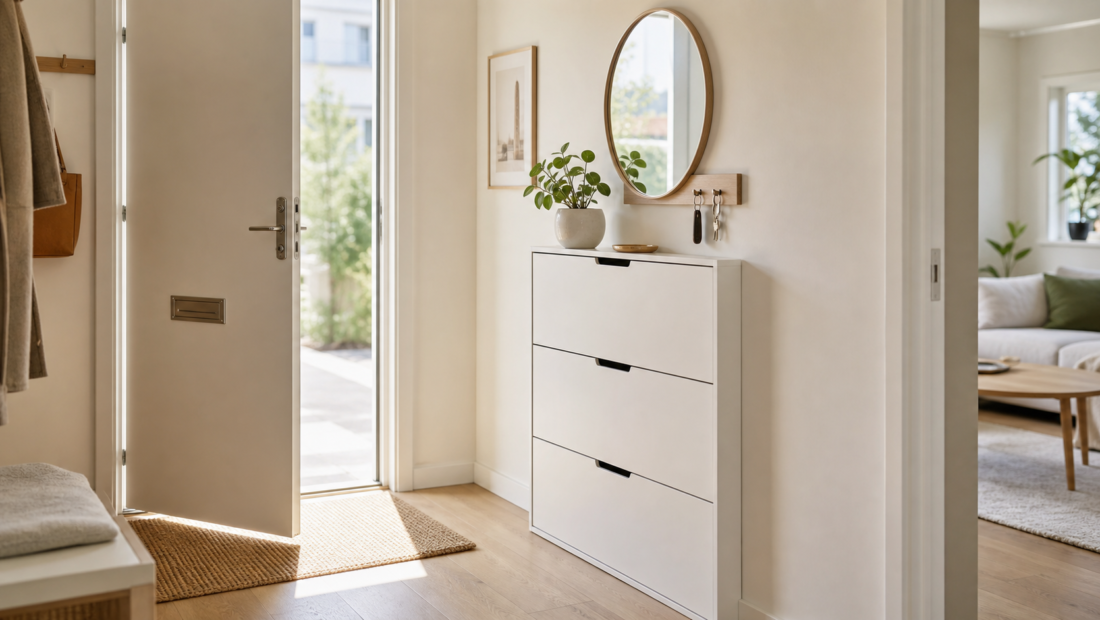
If you have a narrow hallway where a traditional cabinet won’t fit, an ultra-slim tilt-out shoe cabinet (such as the IKEA Trones, Bissa, or Stall series) is the ultimate small space storage hack.
These cabinets feature shallow, vertical drawers that tilt outward at a 45-degree angle.
Why this works so well for small spaces:
Minimal Depth: At only 6 to 7 inches deep, they hug the wall and take up virtually zero floor space.
Concealed Storage: Keeps 6 to 12 pairs of shoes completely hidden from view, eliminating visual clutter at the front door.
Flat Top Surface: The flat top surface functions as a slim entry console to hold a key tray, mail organizer, or small vase.
💡 Renter Safety Tip: Because these cabinets are tall and shallow, secure them to the wall using heavy-duty Command picture hanging strips along the back top edge to prevent tipping without drilling holes.
2. Combine a Floating Ledge with Adhesive Key Hooks
If your front door opens directly into your living room with no hallway at all, you don’t have space for floor furniture.
Build a wall-mounted mini drop-zone using a narrow picture ledge and damage-free hooks.
How to set it up:
Mount a 4-inch deep wooden picture ledge on the wall near the door using heavy-duty Command picture hanging strips.
Use the top ledge to hold outgoing mail, a small framed print, and a key bowl.
Stick 3 to 4 clear Command wire hooks directly underneath the ledge to hang car keys, dog leashes, and sunglasses.
This creates a complete entry organization hub using less than 1 square foot of wall space.
3. Place an Entry Table with Shoe Storage Beneath
If you prefer a traditional entryway table look, opt for an open-frame entry table with a built-in lower shoe rack or shelf.
Instead of solid wooden cabinets that block light, an open metal or wooden frame table feels airy and allows light to pass through.
How to maximize an open entry table:
Top Level: Use decorative trays to sort mail, sunglasses, and wallet items.
Lower Shelf: Place 2 to 3 woven fabric baskets or wire bins on the bottom shelf. Use one bin for everyday shoes, one for umbrellas, and one for tote bags.
Under-Table Space: Slide a small low-profile shoe mat beneath the bottom frame for wet winter boots.
4. Utilize Over-the-Door Shoe & Coat Storage
If your entryway includes a closet door or front coat closet nearby, stop letting the back of that door go unused.
An over-the-door shoe organizer or heavy-duty metal hook rack adds massive storage capacity without touching a single drywall surface.
Renter-Friendly Door Options:
Clear Pocket Organizers: Hang a canvas over-the-door pocket organizer inside your coat closet door. Use the pockets for shoes, umbrellas, lint rollers, and dog gear.
Over-the-Door Hook Racks: Hang a padded metal 6-hook rack over the top edge of the door for heavy winter coats, backpacks, and scarves.
5. Add a Freestanding Storage Bench for Seating + Shoes
If your entryway is wide enough for a small bench, choose a freestanding storage bench with a flip-top lid or lower shoe cubbies.
A storage bench solves two entry problems at once:
It provides a comfortable place to sit while putting on or taking off shoes.
It hides bulky footwear, seasonal boots, or reusable grocery bags inside the base.
Styling Tip: Place a soft linen cushion on top of the bench and hang an adhesive wall mirror directly above it to make a small entry feel wider and brighter.
6. Create a Vertical Pegboard Drop-Zone
When floor space is zero, use a freestanding or leaning pegboard panel to take advantage of vertical wall space.
An IKEA Skådis pegboard or a wooden pegboard unit can be leaning against the wall or mounted using Command picture hanging strips.
How to configure a pegboard for entry items:
Attach small pegboard shelves to hold sunglasses, wallet, and mail.
Add peg hooks at varying heights for keys, coats, and umbrellas.
Attach a small wire basket clip to hold incoming mail and documents.
Because hooks and shelves can be moved around anytime, you can adjust the layout as your seasonal storage needs change.
7. Maximize Awkward 90-Degree Entry Corners
In many city flats, the front door sits directly in a tight 90-degree corner against a side wall. Standard rectangular tables will block the door trim or light switches.
The Fix: Use a corner shoe rack or triangular entryway stand.
Corner furniture utilizes dead 90-degree angle space that is normally wasted. A 5-tier corner shoe rack holds 8 to 10 pairs of shoes in a footprint less than 12 inches wide.
Move-Out Day Entryway Restoration Checklist
When your lease ends, restoring your apartment entry takes under 10 minutes:
Unbox and pack up freestanding shoe cabinets, benches, or rolling carts.
Remove over-the-door organizers and hook racks.
For Command-mounted floating key ledges or pegboards, pull the adhesive tabs straight down slowly along the wall to prevent paint damage. Read our full wall decor hanging guide.
Wipe down hallway drywall and baseboards with a damp microfiber cloth to remove shoe scuff marks.
Q: How do I store shoes in a very narrow apartment hallway? A: Use an ultra-slim tilt-out shoe cabinet (5 to 7 inches deep) like an IKEA Trones unit. It mounts flat against the wall, keeps shoes completely hidden, and leaves hallway walkways clear.
Q: Where do you put keys and mail when you don’t have an entryway? A: Mount a small 4-inch deep picture ledge on the wall near the front door using Command strips, and attach small adhesive key hooks directly beneath it to create an instant vertical drop-zone.
Q: How do you organize shoes at the front door without a closet? A: Combine an ultra-slim tilt-out shoe cabinet, an over-the-door canvas shoe organizer, or a narrow entry table featuring lower shoe baskets to keep footwear off the open floor.
Q: Can you mount a shoe cabinet in a rental without drilling into drywall? A: Yes. Slim lightweight plastic or composite shoe cabinets can be stabilized against the wall using multiple heavy-duty Command velcro picture hanging strips placed along the top back edge.
Final Thoughts
A cramped front door or narrow hallway doesn’t mean you have to live with shoe clutter and scattered keys.
By taking advantage of vertical space — ultra-slim tilt-out cabinets, floating key ledges, over-the-door storage racks, and multi-functional benches — you can create an organized, welcoming entryway that works for your daily routine.
Pick one upgrade this weekend: install a slim shoe cabinet or add a key ledge near your door — and enjoy stepping into a clean, clutter-free home every day.
No shoe clutter. No wall damage. Full deposit returned.
Waqas Rehman
Creator & Lead Editor at HomeDecorza
Welcome to HomeDecorza.com!
I am a home decor writer and enthusiast passionate about finding practical, budget-friendly ways to style rental spaces.
Living in a rental often comes with strict lease limitations — no painting, no drilling, and limited modifications. My goal on this website is to research, test, and curate damage-free decor solutions, temporary kitchen hacks, and move-out repair guides that help renters make their space feel like home while protecting their security deposits.