A Leonida map is the one GTA 6 poster that is also a piece of art. It has coastlines, roads, districts, colour — the graphic order of a real map, with a place you actually care about inside it. Hung well, it reads as decor. Hung badly, it reads as a dorm poster: too small, too high, curling at the corners, taped to the wall.
The difference is not money. It is four decisions: the right size for the wall, a frame or clip that suits a rental, the centre at eye level, and light that shows the map without glaring on the glass. This guide walks through all four, with renter-friendly mounting throughout.
Table of Contents
[Hide]- Pick the right size for the wall
- Frame or clip: make it look deliberate
- Centre it at eye level
- Light it without glare
- FAQ
- What size should a map poster be above a desk?
- How high should I hang a map poster?
- How do I hang a poster without damaging a rental wall?
- Should a map poster have a mat?
- How do I light a framed map without glare?
Pick the right size for the wall
The biggest mistake with map posters is choosing one that is too small. A small print above a full sofa or a wide desk looks lost, and no frame fixes it. Size is a proportion problem, not a taste problem, and there is a simple rule for it: the framed piece should span roughly two-thirds of the width of the wall or the furniture below it — about 60 to 75 percent.

Above a sofa around 200 cm wide, that means a framed map around 120 to 150 cm wide — usually one large 70 x 100 cm print, or a pair of 50 x 70 cm prints side by side. Above a desk or a bed around 160 cm wide, a 50 x 70 cm or 70 x 100 cm framed print usually feels proportionate. For most feature walls, 50 x 70 cm is the minimum starting point; if you want the map to act as the main focal point of the room, 70 x 100 cm is more convincing.
Measure before you buy. Tape a sheet of newspaper or a cut-out of the size you are considering to the wall and live with it for a day. A 70 x 100 cm print is nearly 60 cm wide and over 80 cm tall — bigger than most people expect, and exactly why it works. Leave at least 30 cm of breathing room on each side so the piece does not feel crammed, and remember the frame adds several centimetres to the print size.
One large map creates calm. A gallery wall creates story. If the room already has patterned upholstery, bookshelves or strong features, choose one statement map. If the wall is plain and you want more layers, build a small gallery — the Leonida map as the anchor, plus one or two smaller prints, with 5 to 8 cm between frames and one element repeated throughout: the same frame finish, the same mat colour, or the same map tone.
Frame or clip: make it look deliberate
The frame is what turns a poster into art. A bare print taped to the wall says temporary; the same print in a frame with a mat says intentional. The frame should complement the map and the room, not compete with either.
For a Leonida map, the frame finish sets the mood. A thin black frame sharpens the modern, neon feel of Vice City and suits minimalist rooms. Oak warms up pale maps and works with Scandinavian, coastal and casual interiors. A darker walnut makes the map feel more collected and library-like. If the room already has three or more wood tones, choose black, or the one wood finish that most closely matches the largest piece of furniture.

The mat matters as much as the frame. A mat is the border between the poster and the frame, and it is not optional if you want a high-end look: it keeps the poster from touching the glass, which can damage it over time, and it gives the artwork breathing room, drawing the eye inward. A good rule is a mat at least one and a half to two times the width of the frame itself, in crisp white or off-white. For a map you truly care about, choose glazing with at least 99 percent UV protection — sunlight fades ink, and a Leonida map is mostly colour.
Renters have good no-drill options. A magnetic poster hanger — two wooden rails that sandwich the top and bottom edges — hangs a map beautifully, weighs almost nothing, and leaves no mark at all. Heavy-duty adhesive strips or hooks rated above the frame’s weight work on smooth, clean walls for lightweight frames: clean the wall first, use at least two mounting points so the frame stays level, and wait the full curing time before hanging. A foam-board mount, with the map attached to a rigid board and hung on adhesive strips, handles large maps without a heavy frame. And the simplest option of all: lean a framed map on a desk, a dresser or a shelf. Leaning suits heavier frames, leaves the wall untouched, and lets you move the piece whenever the room changes.
Know the limits honestly. Adhesive does not hold on textured walls, dusty paint or damp surfaces, and it should never be trusted with a heavy framed piece or real glass. If the frame feels heavy, lean it or use a proper picture ledge instead of sticking it.
Centre it at eye level
Where you hang a map is as important as how you frame it, and the rule is the same one galleries use: the centre of the piece should sit at eye level, around 57 to 60 inches — about 145 to 152 cm — from the floor. That is the average adult eye level, and it puts the middle of the map where you actually look, whether you are standing or sitting on the sofa.
Hanging above furniture changes the maths. The bottom of the frame should sit 20 to 30 cm above the top of the sofa, bed or desk — close enough to read as connected to the furniture, far enough that it does not feel crammed. Above a standard 85 cm sofa, the bottom of a 70 x 100 cm frame in a slim frame lands around 105 to 115 cm from the floor, which is comfortable under a standard 2.4 m ceiling.
Do it the measured way, not by eye. Mark the 57-inch centre point lightly on the wall with a pencil. Turn the frame over and measure the distance from the top of the frame to the hanging wire or sawtooth hanger when it is pulled taut. Mark up from the centre point by that distance, and that is where the hook goes. Use a small level before you step back — a map that is a degree off is a map you will notice every day.
For a gallery wall, find the midpoint of the whole arrangement first, then place the Leonida map as the anchor and arrange the smaller pieces around it, keeping 5 to 8 cm between frames.
Light it without glare
A map under the wrong light is a map you cannot read. Direct sunlight is the enemy twice over: it fades the ink, and it glares across the glass. Never hang a map you care about on a wall that takes direct sun, and if the only wall gets sun, choose UV-protective glazing.
The best light for a map is indirect and warm. A small picture light above the frame washes the map evenly without touching it, and a warm bulb keeps the pink and teal tones of Leonida looking rich instead of cold. A desk lamp or floor lamp to the side works too, as long as it lights the map from an angle and never reflects in the glass. Stand where you will actually look at the map and check for glare before you finish — if you can see the bulb reflected in the glass, move the light, not the map.

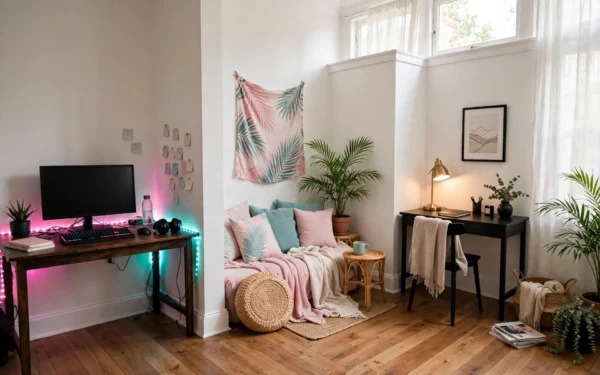
At night, the map can join the rest of the room’s glow. A soft LED strip behind the desk or along a shelf edge, in pink or teal, picks up the colours of the map without shining on it directly. The map stays readable, the room stays moody, and the whole corner feels like it was planned together.
FAQ
What size should a map poster be above a desk?
A 50 x 70 cm framed print is the minimum that holds its own above a desk; 70 x 100 cm works as a focal point. The framed piece should span about two-thirds of the width of the furniture below it.
How high should I hang a map poster?
Centre the piece at 57 to 60 inches (145 to 152 cm) from the floor — average eye level. Above furniture, leave 20 to 30 cm between the top of the furniture and the bottom of the frame.
How do I hang a poster without damaging a rental wall?
Use a magnetic poster hanger, heavy-duty adhesive strips or hooks rated above the frame’s weight on smooth clean walls, a foam-board mount on adhesive strips, or simply lean a framed map on a desk or dresser. Adhesive does not hold on textured or damp walls.
Should a map poster have a mat?
Yes, if you want it to look like art. A white or off-white mat keeps the poster off the glass, protects it, and gives the artwork breathing room. Make the mat one and a half to two times the width of the frame.
How do I light a framed map without glare?
Use indirect warm light — a small picture light above the frame or a lamp to the side — and never place it where the bulb reflects in the glass. Keep the map out of direct sunlight and use UV-protective glazing.