

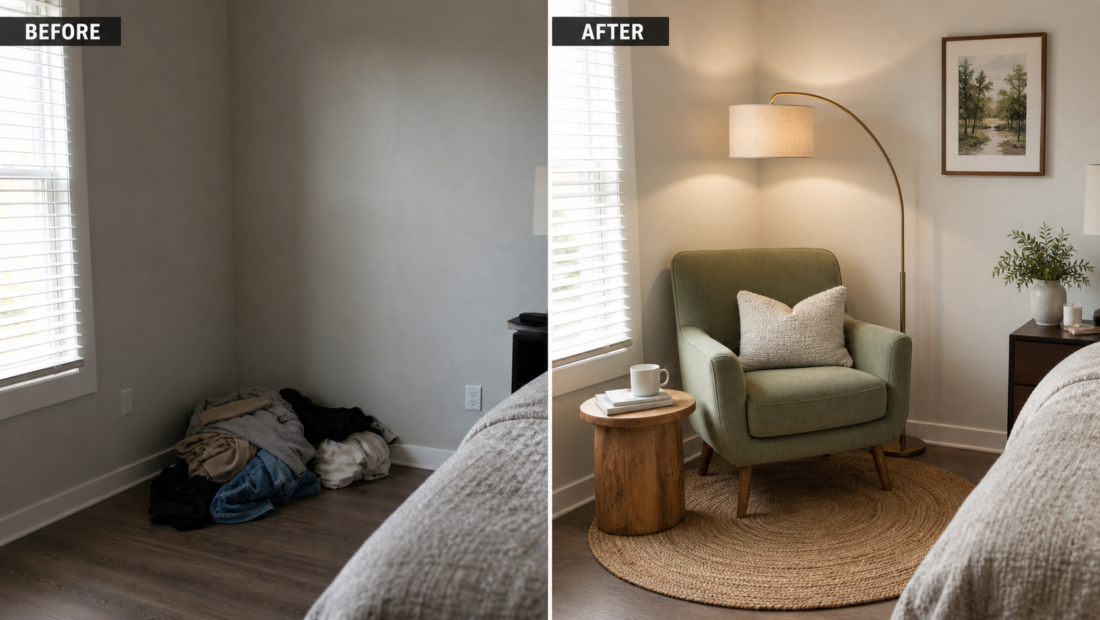
You make your bed, arrange your pillows, and look around your bedroom.
There is an awkward empty corner near the window, or a strange 4-foot gap between the end of your mattress and the wall.
It becomes a dumping ground for laundry piles, empty boxes, or discarded bags.
You want a relaxing spot to sip morning coffee, read a book, or put on shoes — somewhere other than sitting directly on top of your made bed.
However, adding a sitting area to a bedroom presents two big challenges:
- Bulkier armchairs can block walking paths and make a small bedroom feel crowded.
- Heavy furniture arrangements can block closet doors, radiators, or window access.
On subreddits like r/DesignMyRoom, r/femalelivingspace, and r/HomeDecorating, people ask this every week: “How do I set up a cozy sitting area in a bedroom without making the space feel cluttered or blocking walkways?”
The solution lies in smart furniture scale, multi-functional pieces, and clear visual zoning.
Here are 7 practical bedroom sitting area ideas that add comfort and function to any bedroom — no matter how small your floor plan is.
Table of Contents
[Hide]- The 30-Inch Clearance Rule for Bedroom Nooks
- 1. Place a Low-Profile Bench or Loveseat at the Foot of the Bed
- How to choose the right foot-of-bed seating:
- 2. Set Up a Corner Reading Nook with an Open-Leg Accent Chair
- Key elements for a functional corner nook:
- 3. Combine a Vanity Desk & Chair for Dual Purpose
- How to style it:
- 4. Build a Window Sitting Nook with a Low Bench
- Benefits of a window sitting nook:
- 5. Anchor the Sitting Zone with a Small Round Accent Rug
- How to use a zone rug in the bedroom:
- 6. Use Swivel Armchairs for Multi-Zone Rooms
- 7. Add Wireless Layered Lighting Around the Seating Zone
- Move-Out & Rearrangement Checklist
- Frequently Asked Questions
- Final Thoughts
The 30-Inch Clearance Rule for Bedroom Nooks
Before buying an accent chair or loveseat, measure your available floor area carefully.
In any bedroom layout, you must preserve at least 30 inches of clear walkway space along main traffic paths (between the bed and closet, or between the doorway and bathroom).
If a chair forces you to turn sideways to walk past your bed, the furniture scale is too large for the room.
The Golden Rule: Keep your seating lightweight, open-legged, and proportional to your bed size.
1. Place a Low-Profile Bench or Loveseat at the Foot of the Bed
The space directly at the end of your mattress is one of the most underutilized areas in any bedroom.
Adding a slim loveseat, storage bench, or ottoman at the foot of the bed anchors the bed visually and creates an instant seating spot.
How to choose the right foot-of-bed seating:
- Width Match: The bench or loveseat should be slightly narrower than your mattress width (leave 2 to 4 inches of clearance on both ends so it doesn’t stick out).
- Height Rule: The top cushion of the seating should sit 2 to 4 inches lower than the top of your mattress. This keeps sightlines across the room open.
- Storage Bonus: Choose a bench with a flip-top lid or open lower cubbies to store extra blankets, throw pillows, or shoes out of sight.

2. Set Up a Corner Reading Nook with an Open-Leg Accent Chair
If you have a dead 3×3 foot corner near a window or in a bedroom alcove, convert it into a cozy reading nook.
Instead of a heavy, fully upholstered armchair that sits flat on the floor, choose an open-arm accent chair with raised wooden or metal legs.
Key elements for a functional corner nook:
- The Chair: Mid-Century Modern, Scandinavian, or rattan sling chairs allow light and floor visibility to pass underneath, keeping the corner feeling airy.
- The Lighting: Place a tall floor lamp behind or beside the chair for evening reading. Read our guide on wood floor lamps for low-light rooms.
- The Side Table: Add a small 12-inch round accent table to hold a mug, book, or pair of glasses.
3. Combine a Vanity Desk & Chair for Dual Purpose
In small bedrooms or studio apartments, you might not have room for both a dedicated sitting chair and a makeup vanity or work desk.
Combine both functions into a multi-functional vanity desk sitting area.
How to style it:
- Place a slim 16-inch deep desk against an empty wall or near a window.
- Pair it with a comfortable, stylish upholstered chair (rather than an industrial office chair).
- Hang a large decorative mirror on the wall above the desk.
- During the morning, use it as a vanity; during the day, use it as a laptop desk; in the evening, throw a sheepskin rug over the chair to turn it into a cozy reading spot.
4. Build a Window Sitting Nook with a Low Bench
If you have a wide window in your bedroom, do not push your tall dresser or headboard in front of it (blocking natural sunlight).
Place a low-profile storage bench or daybed cushion directly under the window sill.
Benefits of a window sitting nook:
- Maximizes Natural Light: Keeps natural window daylight flowing across the bedroom floor.
- Creates a Focal Point: Turns an ordinary bedroom window into an inviting garden-view seating spot.
- Comfort Upgrade: Layer the bench with a thick seat cushion, two textured throw pillows, and a soft knit blanket.
5. Anchor the Sitting Zone with a Small Round Accent Rug
In a larger bedroom, a chair and side table placed on bare flooring can look like floating, disconnected furniture.
To create a cohesive “room within a room,” anchor your sitting area with a small round rug (3×3 ft or 4×4 ft).
How to use a zone rug in the bedroom:
- Place the front legs of your accent chair and the base of your floor lamp squarely on top of the round rug.
- Choose a textured jute, wool, or faux-fur rug that contrasts with your main bedroom floor or carpet. Learn how to layer rugs without bunching.
- This visually groups the chair, table, and lamp into one intentional sitting zone.
6. Use Swivel Armchairs for Multi-Zone Rooms
If your bedroom doubles as a home office, media room, or open studio, consider a compact swivel accent chair.
A 360-degree swivel chair allows you to adjust your seating direction in one second:
- Morning: Swivel toward the window to enjoy natural daylight.
- Workday: Swivel toward your desk to chat during calls.
- Evening: Swivel toward the bed or TV screen to relax.
Swivel chairs eliminate the need to drag furniture around to face different areas of the room.
7. Add Wireless Layered Lighting Around the Seating Zone
A bedroom sitting area should feel warm and relaxing in the evening. If your sitting nook relies on a single overhead bedroom light, it won’t feel cozy.
Incorporate dedicated secondary lighting around your chair or bench:
- Floor Lamps: A tall arc lamp or wooden tripod lamp next to an accent chair.
- Plug-In Wall Sconces: Hang a plug-in fabric sconce on the wall next to a reading chair using a clear Command hook.
- Table Lamps: Set a small, warm-bulb table lamp on your side table or vanity desk.
💡 Bulb Tip: Use 2700K Warm White LED bulbs in your bedroom sitting area to promote relaxation and prepare your mind for sleep.
Move-Out & Rearrangement Checklist
When reconfiguring your bedroom layout or preparing for a move:
- Measure walkways to confirm you have 30 inches of clear space around the bed.
- Ensure sitting furniture doesn’t block closet doors or under-bed drawers from opening fully.
- Place felt furniture pads on the feet of all accent chairs and benches to protect hardwood or laminate floors from scratches.
- Tuck lamp power cords neatly along baseboards using clear adhesive clips.
- Vacuum and rotate accent rugs periodically to ensure even wear on bedroom carpets.
Frequently Asked Questions
Q: How big should a bedroom be to have a sitting area?
A: You don’t need a massive master bedroom! A small 10×12 ft bedroom can fit a sitting area by using the foot of the bed for a slim bench, or placing a single 30-inch accent chair in a corner with a floor lamp.
Q: What do you put in a bedroom sitting area?
A: The basic setup includes a comfortable seat (accent chair, loveseat, or bench), a small side table or tray to hold drinks/books, and a dedicated light source (floor lamp or table lamp).
Q: How do you arrange furniture in a small bedroom with a chair?
A: Place the bed against the main wall first. Position the accent chair in the opposite corner near a window or at an angle facing the bed, ensuring at least 30 inches of walking space remains clear around all doorways.
Q: Can a loveseat go at the foot of a bed?
A: Yes! A loveseat or settee at the foot of a bed looks high-end and functional. Ensure the loveseat width is slightly narrower than your mattress and that the back height sits lower than the top of your mattress.
Final Thoughts
A bedroom should be more than just a place to sleep — it should be a quiet, cozy retreat where you can relax at any time of day.
By choosing lightweight open-leg chairs, utilizing the foot of your bed, converting window nooks, anchoring zones with small accent rugs, and adding warm secondary lighting, you can build a cozy bedroom sitting area no matter how small your room is.
Pick one corner this weekend: add an accent chair and a floor lamp, or place a bench at the end of your mattress — and enjoy your upgraded bedroom retreat.
No crowded walkways. No heavy built-ins. Beautiful bedroom living.


