
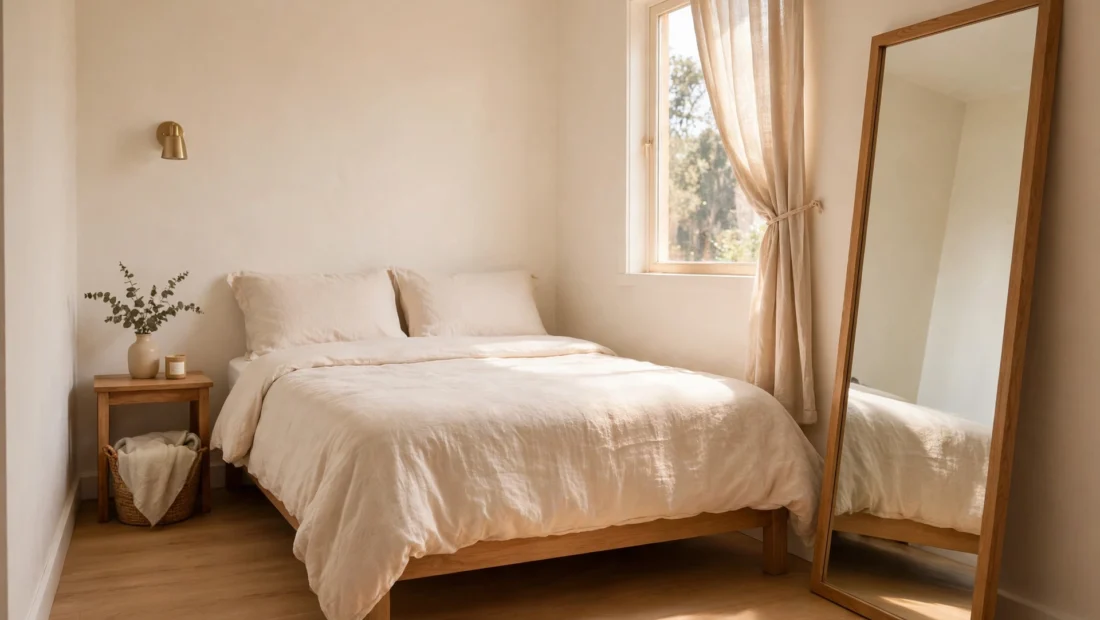
A small bedroom does not have to feel small. Most of the time, what makes it feel cramped is not the floor area — it is a bed in the wrong place, storage that spills out of every corner, and too many competing colours and patterns fighting for attention in a room you can cross in four steps.
Learning how to make a small bedroom bigger, as a renter, is mostly about layout and light, not about knocking down walls or painting the room a new colour (which your lease may not allow anyway). Put the bed where it works, give everything a home that is not the floor, and let mirrors, light, and calm bedding do the rest. No drilling, no remodel, and everything you add can move with you.
This is a feeling-bigger guide, not a full bedroom decorating guide. For headboards and dressers, the summary at the end points you to the site’s dedicated guides rather than repeating them here.
Table of Contents
[Hide]- Layout first: bed, wardrobe and door swing
- Storage beds: are they worth it for a small bedroom?
- Where to put the bed in a small room
- Mirrors, light and colour: feeling bigger without painting
- Storage: under-bed, over-door and vertical
- Bedding and colour: calm, not cramped
- Small bedroom decorating: a summary, not a repeat
- FAQ
- How small can a bedroom be?
- What is a normal bedroom size? / What is the normal size bedroom?
- How many square feet is a small bedroom?
- Where do I put a desk in a small bedroom?
- Can I make a small bedroom feel bigger without painting or drilling?
Layout first: bed, wardrobe and door swing
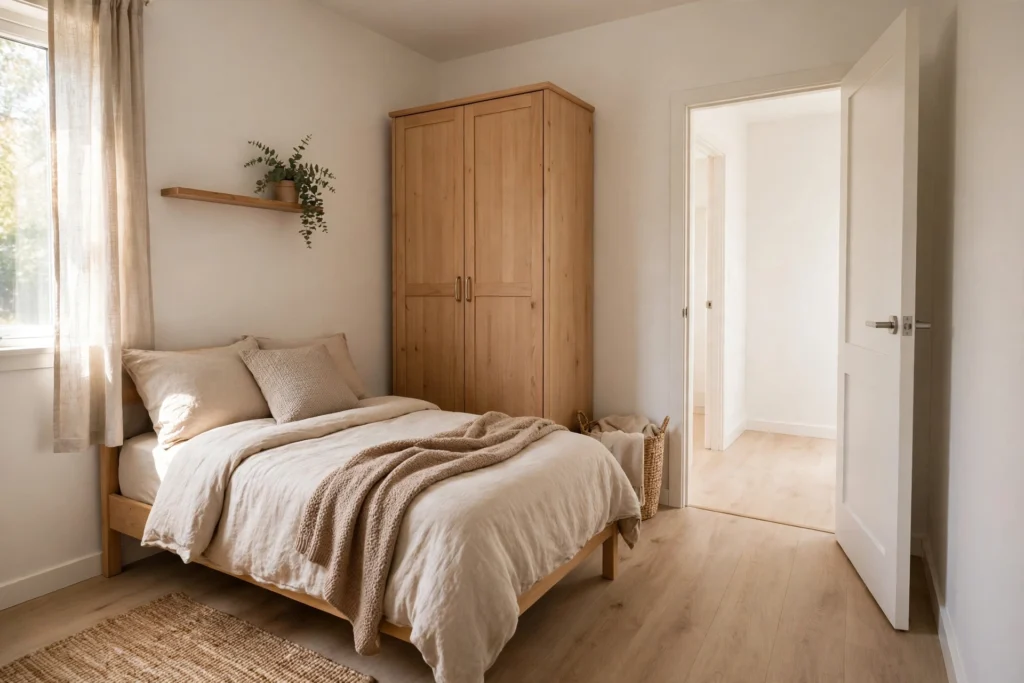
Start with the three things you cannot easily move every day: the bed, the wardrobe (or closet), and the door swing. Get these right first, and everything else falls into place.
Draw it before you move it. Measure the room — length, width, door swing, window positions, radiator or heater positions, and plug sockets — and sketch it on paper or in a free room-planner app. Moving a bed twice in a small room is exhausting; moving it on paper is free. Mark the door swing arc: nothing that blocks the door, or that you have to climb over to get in, belongs in that arc.
Give the bed a wall, not the middle of the room. In most small bedrooms, the bed works best with its head against the longest uninterrupted wall, leaving a walkway on at least one long side. A bed floating in the middle of a small room eats floor space on all four sides and makes the room feel smaller, not more generous.
Keep the wardrobe where it does not fight the bed. If you have a built-in closet, use it — do not add a freestanding wardrobe that duplicates it. If you need freestanding storage, put it on the wall opposite or beside the bed, not in the walkway to the door or window. Leave the window as clear as you can: a blocked window makes a small room feel dark and closed in, whatever else you do.
Leave one clear path. You should be able to walk from the door to the bed and to the window without sidestepping furniture. If you cannot, something is in the wrong place — usually a chair, a laundry pile, or a piece of storage that belongs under the bed or behind the door, not in the middle of the floor.
Storage beds: are they worth it for a small bedroom?
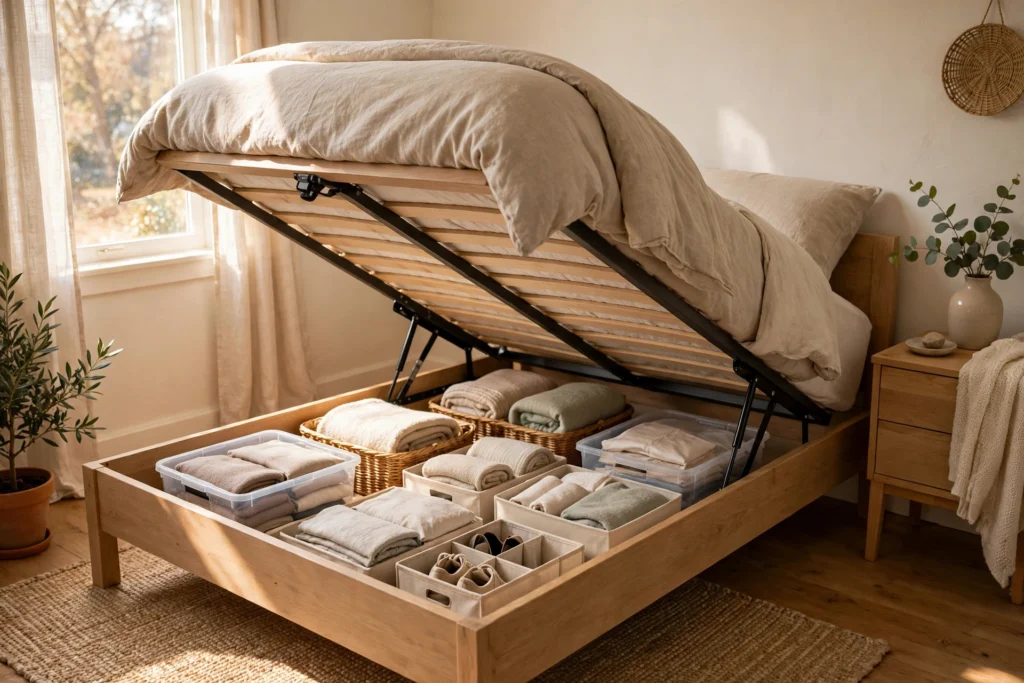
Are storage beds good for small bedrooms? For many renters, yes — with conditions. A storage bed gives you a large, hidden storage area (under the mattress) in a room where floor space is the scarcest thing you own. That is a genuine advantage. But a storage bed is also a big purchase, it is heavy, and it only helps if it suits your room, your mattress, and your move-out plans.
Pros:
- Hidden bulk storage for out-of-season clothes, spare bedding, luggage, and bulky items that would otherwise live in piles or in a second wardrobe.
- One piece of furniture doing two jobs — bed and storage — which matters more in a small room than in a large one.
- A tidier-looking room, because the under-bed area is enclosed rather than an open gap collecting dust and stray items.
Cons:
- Weight and moving. Storage beds are heavier than a basic frame, and ottoman-lift beds need clearance to lift. If you move often, or you live upstairs with no lift, think about how you will get it out again.
- Access. A lift-up ottoman bed needs room around it to open fully; a drawer bed needs clear floor space on the drawer side. In a very tight room, you may not be able to open the storage you paid for.
- Mattress and ventilation. A mattress sitting on a solid storage base gets less airflow underneath than one on slats. If your room is damp, or your mattress maker recommends slats, check that before you buy.
- Cost and commitment. A storage bed is a bigger purchase than a basic frame plus under-bed boxes. If you are only in the rental for a short time, removable under-bed boxes with a standard frame may give you most of the benefit for less commitment.
What to check before buying: your room’s exact dimensions and door swing (will the bed fit through the door and up the stairs?); the storage mechanism’s clearance (lift-up or drawer space); the weight limit and assembly requirements from the maker; and whether your mattress suits a solid base. This draft names no specific storage-bed product, so no dimensions, weight, or assembly claim is made here — the checklist at the end flags maker guidance as a pre-purchase check for any product added at publishing time.
If a storage bed does not suit your room, the next best thing is under-bed boxes or bags on a standard frame: cheaper, lighter, removable, and they use the same dead space without the weight or the lift mechanism.
Where to put the bed in a small room
Where to put the bed in a small room is the question that decides the whole layout, so it deserves its own answer rather than a guess.
Best starting point: head against the longest wall, with a walkway on one long side. This usually leaves the most usable floor, keeps the door swing clear, and gives you a wall for a headboard or wall decor without drilling (see the no-nail guide linked below). If the longest wall has the window on it, put the bed beside the window rather than blocking it, and use the wall next to it.
In a corner: pushing the bed into a corner frees the most floor space, and it works well if you sleep alone or do not mind climbing over to the wall side. If two people share the bed, a corner bed means one person climbs over the other every night — in that case, leave a walkway on both long sides if you possibly can, even if it is narrow.
Under the window: a bed under a window can work in a small room and keeps the walls free for wardrobe and storage, but check for draughts, radiators below the window, and whether you can open the window easily. If the window is your only natural light and ventilation, do not block it with a tall headboard.
What to avoid: a bed that blocks the door swing, a bed that blocks the closet or wardrobe doors, and a bed placed so you have to walk around the foot of it to reach the wardrobe. Each of those turns a small room into an obstacle course, however nice the bedding looks.
If you share the room, agree the layout together before you move furniture. A layout that works for one person’s sleep and storage but blocks the other person’s wardrobe or desk will not last a week.
Mirrors, light and colour: feeling bigger without painting
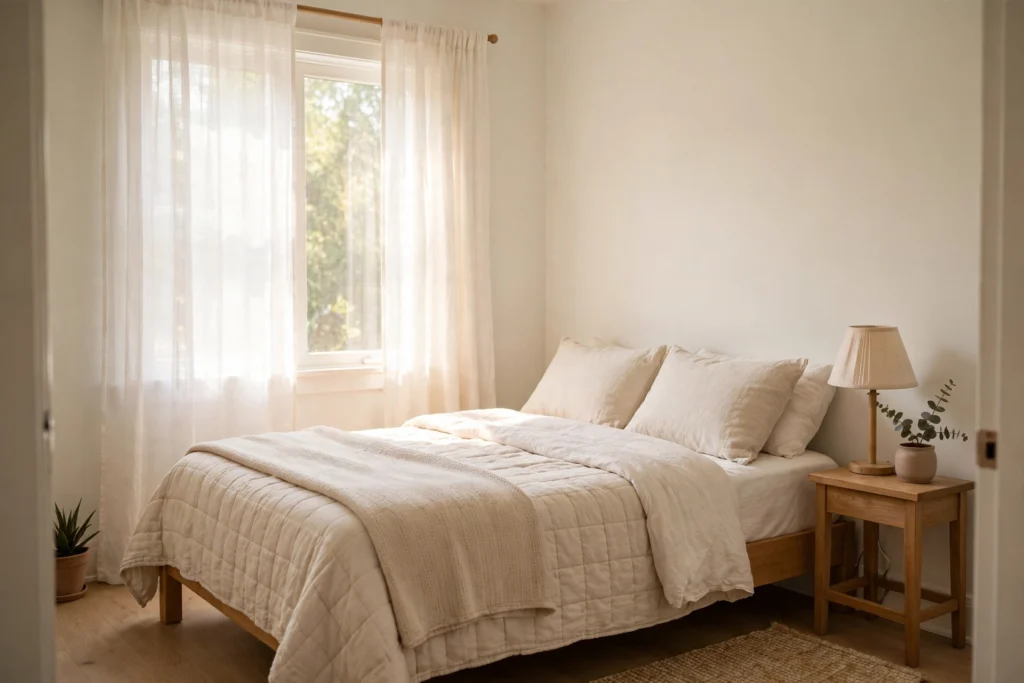
You do not need to paint to make a small bedroom feel bigger. You need light, reflection, and fewer visual interruptions.
Mirrors: one large mirror, leaning against a wall or hung with a no-drill method (lease-checked, and only if the mirror and the hanging method suit the wall), placed opposite or beside a window, bounces light and the view of the room back into the space. That is what makes the room feel larger — not the mirror itself, but the light and the sense of depth it adds. One large mirror works better than several small ones scattered around, which can make a small room feel busy. Keep the mirror clean; a dusty mirror in a small room just reflects dust.
Light: small bedrooms often have one ceiling light and not much else. Add light at different heights — a bedside lamp, a small desk lamp if you work in the room, and warm-toned bulbs in the evening — rather than one harsh overhead light. Keep window coverings light: sheer curtains or light blinds that let daylight in during the day, with a blackout layer at night if you need it for sleep. Do not block the window with tall furniture or heavy, dark curtains that stay closed.
Colour without painting: if you cannot paint (and many renters cannot), colour comes from bedding, curtains, rugs, and art — all removable. Light, calm colours on the largest surfaces (bedding, rug, curtains) make the room feel more open than dark, heavy patterns on every surface. That does not mean the room has to be white: soft, muted tones, a single accent colour repeated in two or three places, and plain bedding with one textured throw will feel calmer and larger than a room where the bed, curtains, rug, and walls all compete. For a full guide to working with white walls specifically, see the white-walls guide linked below (once published).
Keep the floor visible. A rug that covers most of the floor, in a light tone, makes the floor read as one surface. A room where you can see patches of bare floor between small rugs and furniture looks chopped up — and chopped up reads as smaller.
Storage: under-bed, over-door and vertical
How to maximize space in a small apartment starts, in the bedroom, with using the space you already have: under the bed, behind the door, and up the walls.
Under-bed: boxes, bags, or drawers for out-of-season clothes, spare bedding, and luggage. Label them, and keep a simple rule: if you have not opened a box in a year, it does not need to live under your bed. Under-bed storage only helps if you can actually slide it out — leave clearance, and do not pile things on top of the boxes.
Over-door: a removable over-door rack or hooks on the bedroom door (or the inside of a closet door) holds bags, robes, belts, and accessories without drilling and without taking floor space. Check the door still closes and latches, and that the rack does not damage the door or frame. Remove it when you move out and check for marks.
Vertical: tall, narrow storage uses wall height instead of floor area — a tall bookcase, a narrow shelving unit, or wall-mounted shelves only if your lease allows them and you are prepared to repair the fixings on move-out. For most renters, freestanding tall storage is the safer choice: it moves with you, it needs no drilling, and it can be secured against tipping if the maker recommends it (especially important if children or pets use the room — follow the maker’s anti-tip guidance). Use the top shelves for light, rarely used items, and keep everyday items at waist to eye level so you are not climbing to reach them daily.
One in, one out. Small bedrooms stay small-bedroom-sized only if the amount of stuff in them stays roughly constant. When something new comes in — a new jumper, a new bag, a new book pile — something old goes out, to donation, recycling, or another room. Without that rule, even the best storage fills up, and the room starts to feel small again.
Bedding and colour: calm, not cramped
Bedding is the largest surface in a small bedroom. It sets the colour and the mood of the whole room, so it deserves more thought than “whatever was on sale.”
Choose plain or lightly textured bedding in a light, calm tone, with one throw or a couple of cushions for accent — not a busy pattern on the duvet, the cushions, the curtains, and the rug all at once. A plain duvet with a folded throw at the foot of the bed looks intentional and calm; a bed piled with cushions you have to remove every night just adds a nightly chore and a daytime pile on the floor or a chair.
Keep the bed made. It sounds trivial, and in a small room it is the difference between “tidy bedroom” and “messy bedroom” in five minutes. A made bed, a clear floor, and one clear surface (a bedside table with just a lamp and a book, not a pile) make a small room feel finished, even when it is not large.
If you share the bed, agree on bedding that works for both sleepers — temperature, weight, and how many pillows you actually use — rather than adding layers to please one person and overheating the other. Sleep matters more than styling, and a small bedroom that sleeps well feels better than a styled one that does not.
Small bedroom decorating: a summary, not a repeat
This guide has covered layout, storage beds, bed placement, light, storage, and bedding — the things that make a small bedroom feel bigger. For the decorating details, the site already has dedicated guides, and this section points to them rather than repeating them:
- Headboards: renter-friendly headboard ideas — freestanding, leaning, and no-drill options that work in a small room without taking floor space. See /renter-friendly-headboard-ideas/.
- Dressers: bedroom dresser decor ideas — how to style the top of a dresser without cluttering it, and what to keep on it versus inside it. See /bedroom-dresser-decor-ideas/.
- Sitting areas: bedroom sitting area ideas — if your small bedroom has a corner that could hold a chair, how to make it a reading spot rather than a dumping ground. See /bedroom-sitting-area-ideas/.
- Walls without nails: no-nail wall decor — hanging art, mirrors, and decor without drilling, with lease checks. See /no-nail-wall-decor/.
- White walls: how to decorate a rental with white walls — warmth, textiles, and light for a white-walled bedroom. See /how-to-decorate-rental-white-walls/ once published.
If your small bedroom is also your workspace, the desk question is answered in the FAQ below — and the work-from-home setup guide (next batch) will cover desk layouts in more depth when it is written.
FAQ
How small can a bedroom be?
There is no single universal answer, and this guide does not state one as a fact. Minimum bedroom sizes vary by country, state or local rules, building codes, and tenancy standards, and they change over time — so a figure quoted without a source and a place is not reliable. As a general guide, a room that fits a single bed, a small wardrobe or closet, and a walkway around the bed will feel workable; a room where the bed blocks the door, the wardrobe, or the window will feel too small whatever its measurements. If you need a legal minimum for your area — for example, because you are renting out a room or checking whether a room can legally be called a bedroom — check your local building or tenancy standards from an official source for your area, and do not rely on a general article figure. The checklist at the end flags this as unverified for a specific figure.
What is a normal bedroom size? / What is the normal size bedroom?
Again, “normal” depends on where you live and what the home was built for. In general terms, a main bedroom in a family home is usually noticeably larger than a second or third bedroom, which in turn is larger than a box room or single bedroom — but this guide does not quote specific square-foot figures as facts, because published averages differ by source, country, and housing type, and no single verified source was used for this draft. As a practical rule for renters: measure your own room, check that the bed, wardrobe, and door swing fit with a clear walkway (as in the layout section above), and judge the room by whether it works for sleep, storage, and movement — not by whether it matches an average. If a specific figure is added at publishing time, it must come with a verified, cited source for the place and housing type it describes; otherwise it stays as a general range with a source note. See the checklist.
How many square feet is a small bedroom?
For the same reason as above, this draft does not give a single square-foot threshold as a fact. Small is relative: a bedroom that feels small in a large house may feel generous in a city apartment. A more useful test is functional: can you fit a bed, storage for your clothes, and a clear path to the door and window without blocking any of them? If not, the room is functionally small for your needs, whatever its floor area. Any square-foot figure added later needs a verified source, as flagged in the checklist.
Where do I put a desk in a small bedroom?
Put the desk where it does not block the bed, the wardrobe, or the door swing — usually against a wall beside the bed, under or beside a window for daylight, or in a corner that would otherwise be dead space. Keep it small: a desk that fits your laptop and a notebook, not a desk that tries to hold everything you own. Use vertical storage above or beside it (a small shelf unit, if your lease allows it, or a freestanding unit) rather than spreading desk items across the bed or the floor. If you work from home full-time in a small bedroom, a desk that folds away or a laptop table you can pack up at the end of the day keeps the room feeling like a bedroom at night, not an office you sleep in.
Can I make a small bedroom feel bigger without painting or drilling?
Yes — that is the whole approach of this guide. Layout first, one large mirror and layered light, calm bedding and curtains, under-bed and over-door storage, and a clear floor and a made bed will make most small bedrooms feel larger without a single hole in the wall or a coat of paint. Painting and drilling are options only if your lease allows them, and they are not needed for the feeling-bigger effect.


